

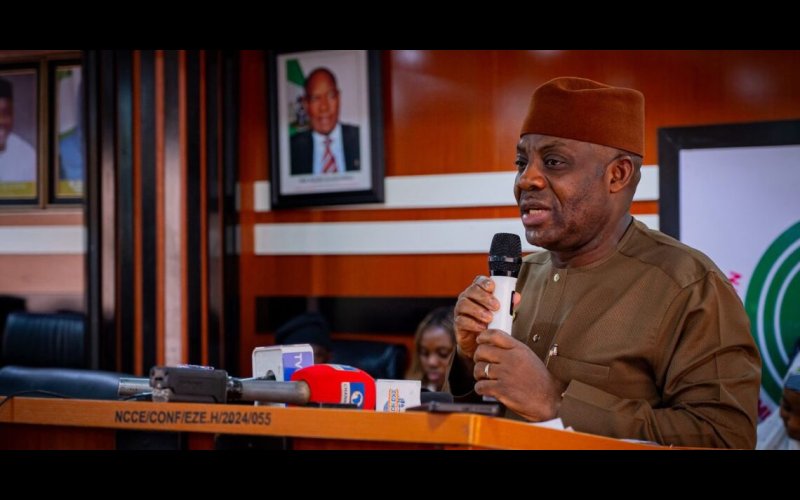
The Federal Government has announced the completion of
a comprehensive review of Nigeria’s national curriculum for basic, senior
secondary, and technical education, marking the most significant reform in over
a decade.
According to a statement by Boriowo Folasade, Director
of Press and Public Relations at the Federal Ministry of Education, the
announcement was made on behalf of the Honourable Minister of Education, Dr.
Maruf Tunji Alausa (CON), by the Minister of State for Education, Professor
Suwaiba Said Ahmad.
Professor Ahmad explained that the review was
conducted in collaboration with the Nigerian Educational Research and
Development Council (NERDC), Universal Basic Education Commission (UBEC),
National Senior Secondary Education Commission (NSSEC), and the National Board
for Technical Education (NBTE).
Curriculum Breakdown
The revised framework reduces subject overload while improving content depth
and learning quality. Students will now be required to take the following:
“The review process was not only about streamlining
subjects but also about enhancing content to allow for deeper learning,” Ahmad
said. She added that the ultimate goal is to deliver education that is
“practical and future-ready.”
Implementation and Monitoring
The Ministry confirmed that the new curriculum will be rolled out nationwide
with strict monitoring to ensure effective adoption and a smooth transition
across schools. Stakeholders involved in the process were commended for their
teamwork and commitment to producing what the government describes as a
“stronger, future-focused curriculum.”
Background
The secondary school curriculum currently in use was introduced in 2011 and had
remained unchanged until now. Reform discussions gained momentum in 2024 when
then-Minister of Education, Prof. Tahir Mamman, disclosed plans for a new
curriculum, 12 years after the last review.
Earlier in January 2025, the Federal Government
introduced 15 new trades—including plumbing, event management, solar
installation, garment making, and digital literacy—into the basic education
curriculum to equip students with practical skills.
In February 2025, the National Council on Education
debated a proposed shift from the 9-3-4 system to a 12-year basic education
model. While the Ministry argued that it would better align Nigeria with global
standards, the Nigeria Union of Teachers (NUT) criticized the move, saying poor
funding—rather than curriculum structure—remains the sector’s most pressing
challenge.
Despite these concerns, the Federal Government insists
that the new curriculum marks a crucial step toward improving learning outcomes
and preparing Nigerian students for the demands of the modern world.
Comments:
Leave a Reply