

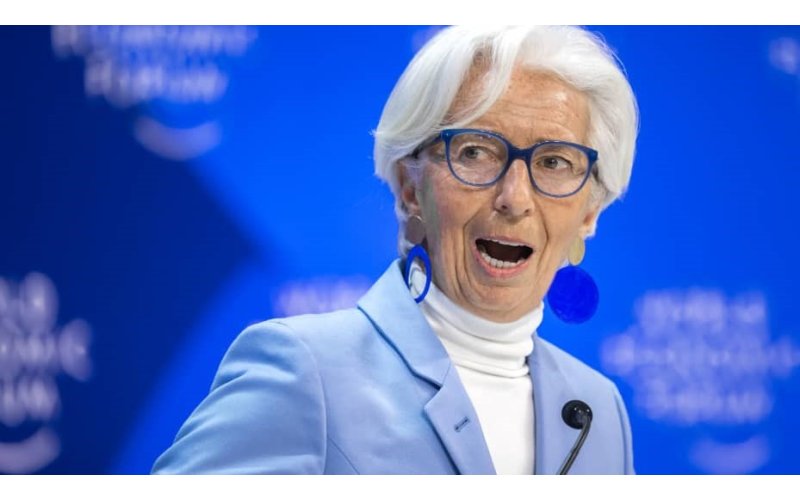
President of the European Central Bank (ECB) Christine
Lagarde attends a session on the closing day of the World Economic Forum (WEF)
annual meeting in Davos, on January 19, 2024.
European
Central Bank President Christine Lagarde said she does not expect a
return to economic “normality” in 2024, despite seeing a balancing of certain
data points throughout the last 12 months.
Speaking on a Bloomberg panel at the World Economic Forum in
Davos, Switzerland, Lagarde described the post-pandemic period as “strange,
extraordinary and difficult to analyze” and identified three trends that began
to normalize last year: consumption, trade and inflation.
The pandemic saw spending fall and people’s savings grow,
while global trade was also disrupted. In October 2022, euro zone inflation hit
10.6% but dropped
off in 2023, coming in at 2.9%
in December.
“In ’23 we have seen the beginning of normalization,” she
said on Friday. “When you look at consumption for instance, around the world …
consumption is still a driving force for growth, but the tailwind that we had
the benefits of, are gradually fading,” Lagarde said. Consumption softened, she
said, as the jobs market became a little less tight and consumers’ savings
reduced.
Trade, meanwhile, was disrupted by consumers’ preference for
buying services over goods in 2021 and 2022, Lagarde said. “But it is beginning
now to really pick up and in October, we had global trade numbers that for the
first time in many months was up.”
The World Trade Organization (WTO) expects trade to increase by 3.3% in 2024, per a forecast released
in October.
Lagarde also noted the broad fall in inflation in 2023.
“Around the world, inflation is coming down, and we have seen it in November
[in] both headline inflation and core inflation,” she said.
“So that’s what I call the normalization that we have
observed in ’23,” Lagarde said on the panel, adding somewhat cryptically: “And
maybe you’ll give me the floor another time to talk about it how it is not
normality that we are heading to.”
In December, the ECB opted
to hold rates unchanged for the second time in a row, shifting its
inflation outlook from “expected to remain too high for too long” to
expectations that it will “decline gradually over the course of next year.”
Speaking on the same panel, WTO Director General Ngozi
Okonjo-Iweala agreed that the economy is “maybe moving towards normalization”
but she described it as “not normal, because trade growth is still trending
below GDP growth.”
Okonjo-Iweala noted uncertainties that make forecasting
“difficult,” including geopolitical conflicts, disruption in the Red Sea and
elections around the world.
A ‘new normal’
Germany’s Minister of Finance Christian Lindner characterized
the current economic situation as a “new normal.”
Speaking on the same WEF panel, he said: “Looking to what
will come over the next years, Christine [Lagarde] said OK, and we are in the
process of normalization. I would say we are witnessing a new normal and 2023
marks this new normal.”
“Think about the race of artificial intelligence … think
about the geopolitical tension and the threat of fragmentation we will have to
deal with over the next years. The higher debt levels after the pandemic and
the energy price hikes, which has shrunk our fiscal space to finance
transformation, and given ... very little growth perspective of the global
economy,” Lindner added.
“Has 2023 given me hope? … I would put it this way: It was a
call for action because we have to rearrange some policies and … probably we
are at the beginning of an era of new structural reforms,” he said.
Germany’s economy — Europe’s largest — contracted
0.3% year-over-year in 2023, its Federal Statistical Office said Monday.
The office said that the German economy stagnated in the third quarter,
implying the country has narrowly avoided a technical recession.
Comments:
Leave a Reply