

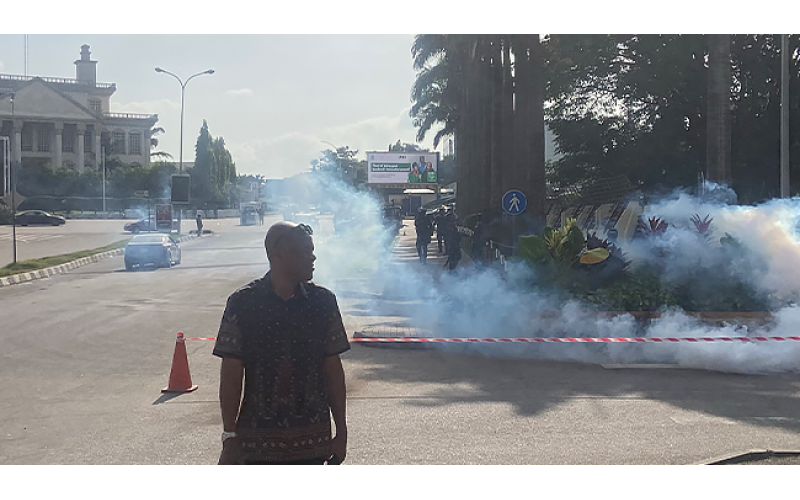
Security operatives fired tear gas to disperse
protesters in Abuja on Tuesday as activist Omoyele Sowore led a march
demanding the release of detained IPOB leader Nnamdi Kanu, defying a
court order and police warnings.
The protesters, who gathered near Transcorp Hilton
and other parts of the Federal Capital Territory, chanted slogans such as “Free
Nnamdi Kanu now,” “It’s our constitutional right to protest,” and “Don’t
tear gas us.” Despite volleys of tear gas, some demonstrators shouted “Tear
gas cannot stop us” as they fled the scene.
Police arrived early at protest points, barricading
major access routes to Aso Rock, Eagle Square, Unity Fountain,
and the Three Arms Zone. All roads leading to the Federal Secretariat
and nearby government buildings were sealed off.
Eyewitnesses reported that officers also fired tear
gas near the Nigeria Union of Journalists (NUJ) secretariat in Utako,
dispersing a crowd that was not part of the protest.
Sowore, speaking later on Channels Television’s The
Morning Brief, said the organisers had duly informed police before the
rally. He alleged that “some protesters were arrested, and even bystanders were
forced into police vehicles.”
He accused the Federal Government of deliberately
stalling Kanu’s trial, urging authorities to “present their evidence before the
court” instead of keeping him in prolonged detention.
The protest went ahead despite an interim injunction
by Justice Mohammed Umar of the Federal High Court, restricting
demonstrations around key government sites, including the Presidential Villa,
National Assembly, and Force Headquarters. Police had warned that
any breach of the order would attract arrest, saying they would use digital
evidence to track online incitement.
Sowore, however, rejected the legality of the
injunction, questioning why “no such order targeted protesters opposing Kanu’s
release.” He revealed that 115 lawyers had volunteered to challenge the
alleged order once served.
Kanu, leader of the proscribed Indigenous People of
Biafra (IPOB), was first arrested in 2015 on treason charges and
later released on bail. He fled Nigeria during his trial but was re-arrested
in Kenya in 2021 and extradited under controversial circumstances.
Earlier this month, the Federal High Court dismissed
his no-case submission, clearing the way for him to face terrorism-related
charges. His lawyers have raised concerns about his deteriorating health
and requested his transfer to the National Hospital, Abuja.
Governors from the Southeast region have
continued to appeal for Kanu’s release, arguing that it would help calm
regional tensions.
The protest also coincided with the fifth
anniversary of the #EndSARS movement, which called for police reform and
justice for victims of brutality. Many Nigerians marked the day in remembrance
of those killed during the Lekki Toll Gate incident in 2020.
Comments:
Leave a Reply