

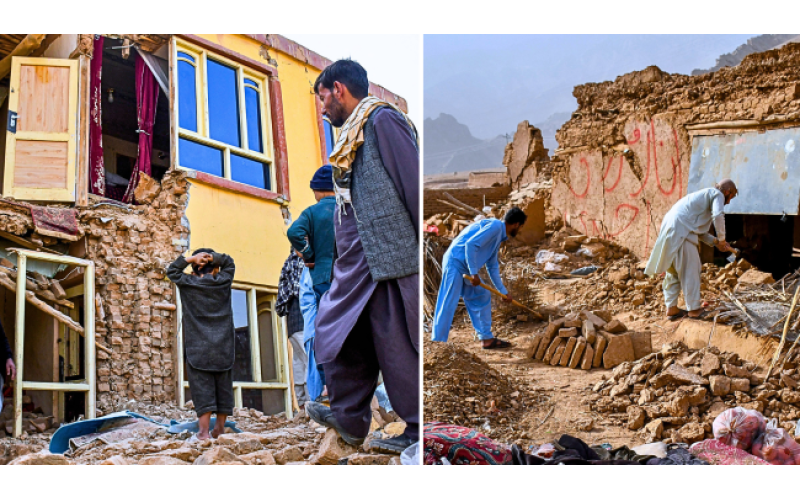
A powerful 6.3-magnitude earthquake struck
northern Afghanistan overnight, killing at least 20 people and injuring
more than 500, authorities confirmed on Monday. The tremor is the latest
in a series of devastating quakes to hit the country in recent months.
According to the U.S. Geological Survey (USGS),
the quake occurred at a depth of 28 kilometres (17 miles) with its epicentre
near the city of Mazar-i-Sharif, one of Afghanistan’s largest northern
hubs.
Health ministry spokesman Sharafat Zaman told
journalists that “534 people have been injured and more than 20 fatalities
have been taken to hospitals in Samangan and Balkh provinces.”
In Mazar-i-Sharif, residents fled into the streets in
panic as buildings shook violently. The city’s iconic Blue Mosque, a
15th-century landmark famous for its turquoise tiles, suffered structural
damage. Portions of one of its minarets collapsed, scattering debris across the
mosque grounds.
Residents in Kabul, located about 420
kilometres to the south, also reported feeling the tremor.
Poor communications and rugged terrain have hampered
early rescue operations, with officials warning that the true scale of
casualties and destruction could rise as teams reach remote villages.
Deputy government spokesman Hamdullah Fitrat
said on X (formerly Twitter) that “numerous homes have been destroyed, and
significant material losses have been incurred,” while the defence ministry
confirmed that the main road between Mazar-i-Sharif and the town of Kholm has
been reopened after being cleared of debris.
This disaster adds to the growing list of natural
calamities confronting Afghanistan’s Taliban-led government, which has
faced three major earthquakes since seizing power in 2021. International
aid has sharply declined during the same period, complicating emergency
response efforts.
In August 2025, a 6.0-magnitude quake in
eastern Afghanistan flattened entire villages and killed more than 2,200
people, causing an estimated $183 million in damages, according to
the World Bank.
Earthquakes are common in Afghanistan, particularly
along the Hindu Kush mountain range, where the Eurasian and Indian
tectonic plates collide.
Decades of war and economic hardship have left much of
the country’s housing infrastructure weak and vulnerable. Most rural homes are
poorly built and cannot withstand strong tremors.
The quake comes amid a deepening humanitarian
crisis, worsened by drought, economic sanctions on the banking system, and
mass deportations of Afghans from neighbouring Iran and Pakistan.
Aid agencies and the United Nations have warned
that hunger and displacement are on the rise, leaving millions at risk as
winter approaches.
Comments:
Leave a Reply