

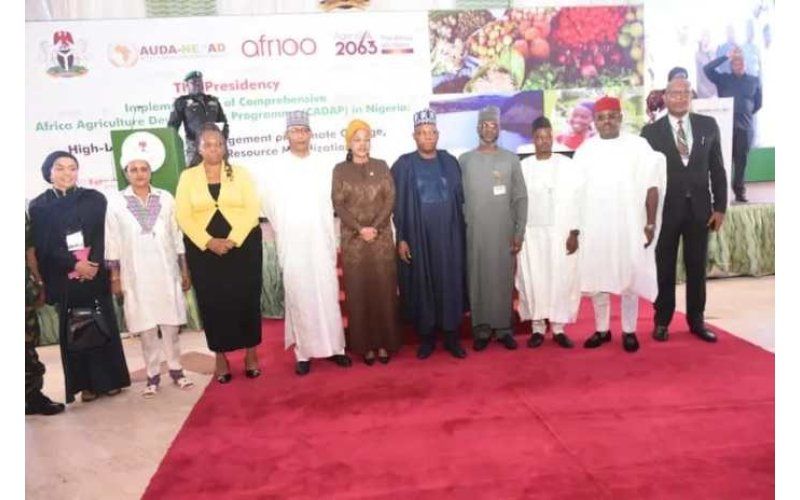
The Federal Government plans to establish a National Commodity
Board as a solution to the escalating food inflation in the country.
Vice President Kashim Shettima made this known on Tuesday at a
two-day, high-level strategic meeting on climate change, food systems and
resource mobilization, held in Abuja.
Shettima explained that the board would be given the mandate to
assess and regulate food prices, as well as maintain a strategic food reserve
for stabilizing prices of crucial grains and other food items.
He said the event was an attestation of Nigeria’s efforts at
mitigating the effects of climate change and ensuring food security for
Nigerians.
Shettima noted that food security was one of the eight areas of
priority declared by President Bola Tinubu as part of his Renewed Hope Agenda.
This, according to him, led to the declaration of a state of
emergency on food security.
He highlighted ongoing policy reforms by the administration to
ensure food and water availability, as well as affordability.
“Our solution to the potential food crisis has become immediate,
medium, and long-term strategies.
“The short-term strategy entails revitalizing food supply
through specific interventions like the distribution of fertilizers and grains
to farmers and households to cushion the effects of subsidy removal.
“It also entails fostering collaboration between the Ministries
of Agriculture and Water Resources for efficient farmland irrigation, ensuring
year-round food production; and addressing price volatility by establishing a
National Commodity Board.
“This board will continually assess and regulate food prices,
maintaining a strategic food reserve for stabilizing prices of crucial grains
and other food items.”
He assured that the Tinubu administration was fully investing in
the restoration of degraded land.
According to him, there are ongoing plans to restore four
million hectares, or nearly 10 million acres of degraded lands within the
nation’s borders as its contribution to the AFR100 Initiative.
“I wish to assure you that we will engage our security
architecture to protect the farms and the farmers so that farmers can return to
the farmlands without fear of attacks.
“We won’t only make it safe for farmers to return to their
farms, but we will also ensure the activation of land banks.
“There is currently 500,000 hectares of already mapped land that
will be used to increase the availability of arable land for farming, which
will immediately impact food output.”
Shettima said the Tinubu administration was collaborating with mechanization
companies to clear more forests and make them available for farming.
He said the Central Bank of Nigeria will also continue to play a
major role in funding the agricultural value chain.
“We will deploy concessionary capital to the sector, especially
towards fertilizer, processing, mechanization, seeds, chemicals, equipment,
feed, labor, among others.
“The concessionary funds will ensure that food is always
available and affordable, thereby having a direct impact on Nigeria’s Human
Capital Index (HCI).
“This administration is focused on ensuring the HCI numbers,
which currently rank as the 3rd lowest in the world, are improved for increased
productivity.”
Earlier, Princess Gloria Akobundu, National Coordinator, African
Union Development Agency- New Partnership for Africa’s Development (AUDA-NEPAD)
Nigeria, commended Tinubu for his efforts towards making Nigeria a great
nation.
“We are happy with the resolve by the administration of President
Bola Tinubu to stand undeterred by any odds in his objective to build a viable,
effective and great nation.”
Akobundu said NEPAD decided to convene the stakeholders’ forum
in order to strengthen small holder farmers in Nigeria as a way of addressing
food shortage problem in the country.
Comments:
Leave a Reply