

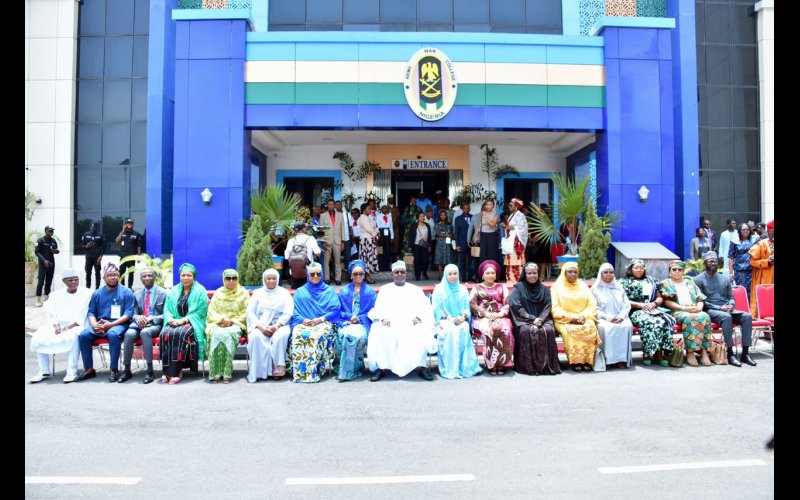
Vow to support NDLEA efforts at state level, cascade
national initiative to communities
The Nigeria Governors Spouses’ Forum (NGSF) has said
that the success of the ongoing efforts by the National Drug Law Enforcement
Agency (NDLEA) against the menace of substance abuse and illicit drug
trafficking will lead to the actualization of the renewed hope agenda of the
President Bola Ahmed Tinubu administration.
“Recalling the importance that successfully tackling
the drug scourge will remarkably ensure that the Renewed Hope Agenda of the
President is achievable for holistic national development required to birth a
Nigeria of our collective dreams”, wives of state governors declared as part of
their resolutions in a communique read by the first lady of Ogun state, Mrs.
Bamidele Dapo Abiodun on behalf of the Chairperson of the Forum and first lady
of Kwara state, Prof (Mrs.) Olufolake Abdulrasaq, at the end of a training
workshop organized by the NDLEA in collaboration with the NGSF in Abuja on
Tuesday 6th May 2025.
The Forum expressed concern “that Nigeria presently
faces an alarming drug use situation, which has heavily pervaded every sphere
and strata of communities and consequently endangering the wellbeing and
security of individuals, families and communities within the country.” It
reiterates that states play critical roles as stakeholders in addressing
national drug challenges by implementing localized strategies, fostering cross
sector collaboration and aligning with internal frameworks, towards responding to
community needs and contributing to coordinated national responses.
The Forum endorsed the “outstanding efforts of NDLEA
under the leadership of Brig Gen Mohamed Buba Marwa against drug use and
trafficking with phenomenal national and global success records in the areas of
arrests and seizures, prosecutions and convictions, prevention, treatment, and
rehabilitation among others.”
In its resolutions, the Forum acknowledged “with
urgency the need for the First Ladies to use their good offices to liaise with
the State Governors in facilitating the establishment, of State Drug Control
Committees (SDCCs) in the thirty-six states of the country, beyond the nine
functional committees currently in existence.”
It said the laudable partnership between NDLEA and the
NGSF has yielded significant dividends and achieved notable milestones over
time, adding that “urgent concerted and pragmatic efforts are required
considering the complex public health issues and security challenges, the
country is witnessing, which is fuelled largely by the use of drugs.”
The Forum called on the Federal Government and
Governors to declare state of emergency on drug use and the illicit trafficking
pandemic with a view to accepting national ownership of the drug problem and
mobilising resources to dismantle the menace.
They also resolved to ensure that “Local Government
Drug Abuse Committees are established in line with the ‘bottom to top’
approach, a core principle of the NDCMP, in ensuring that tailored Drug Demand
Reduction activities are further cascaded to the wards and rural communities,
areas highly vulnerable to the drug problem”
According to them “the Drug Abuse Prevention Treatment
and Care (DPTC) programmes in States continue to serve as Forum project, and to
be chaired by the first ladies of the State, as additional tools for addressing
community-based drug prevention, use and treatment modalities to promote
community health, development and overall wellbeing.”
They highlighted the importance of the SDCCs in
expanding its scope by seeking result-oriented partnerships with the private
sector, civil society organisations and other key stakeholders in the
development and implementation of community-based projects, through the
enhancement of resources, facilities and infrastructure for holistic outcomes
across the States of the Federation;
They also reaffirmed “the need for active
collaboration with, and providing vital supports to NDLEA Commands in States
with a view to achieving more effective, integrated and enduring responses to
drug challenges in diverse community settings by combining enforcement,
prevention, treatment and recovery efforts.”
The Forum harped on “the need to create and promote
sustainable development initiatives by encouraging health and people centered
prevention, treatment, social support, stigma reduction, and inclusive policies
that tackle root causes and ensure long term community and health and
resilience.”
Comments:
Leave a Reply