

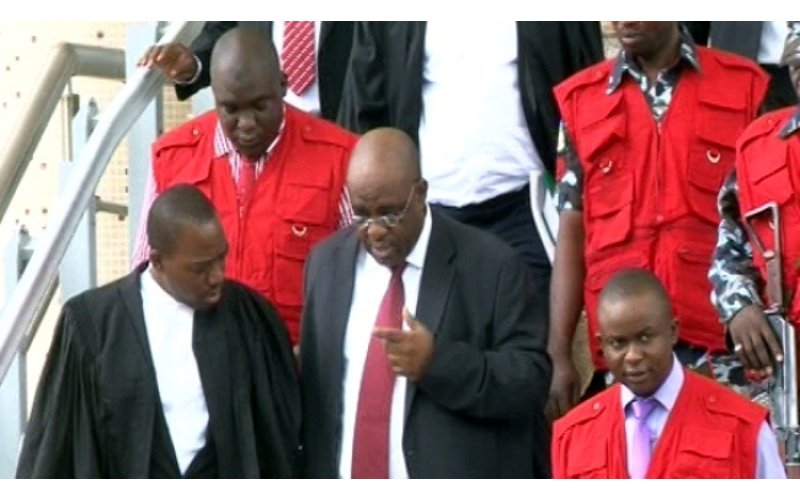
The Supreme Court has upheld the extradition of former
Managing Director and Chief Executive Officer of the Nigerian Security Printing
and Minting Company (NSPMC), Emmanuel Okoyomon, to the United Kingdom to face
bribery-related charges.
In a unanimous ruling delivered on Friday, June 5, a
five-member panel of the apex court dismissed Okoyomon's appeal challenging an
earlier judgment that authorised his extradition.
The appeal sought to overturn the June 6, 2016
decision of the Court of Appeal in Abuja, which affirmed a Federal High Court
order granting the Federal Government permission to extradite him to the UK for
prosecution.
The Supreme Court panel, led by Justice Mohammed
Garba, ruled that the appeal lacked merit and found no reason to interfere with
the decisions of the lower courts.
The lead judgment, prepared by Justice Emmanuel Agim
and delivered by Justice Mohammed Idris, held that the appellant failed to
establish sufficient grounds for the Supreme Court to reverse the concurrent
findings of both the Federal High Court and the Court of Appeal.
Consequently, the court dismissed the appeal, although
it declined to award costs against Okoyomon.
The case originated from an application filed by the
Attorney General of the Federation seeking Okoyomon's extradition to the United
Kingdom, where he is wanted in connection with an alleged international bribery
scheme involving officials of the Central Bank of Nigeria, the Nigerian
Security Printing and Minting Company, and Securency International Pty Ltd, an
Australian firm.
Following the Federal High Court's approval of the
extradition request in 2015, Okoyomon challenged the decision at the Court of
Appeal, arguing that his constitutional right to a fair hearing had been
violated.
However, the appellate court rejected most of his
arguments.
In its judgment, delivered by Justice Moore Adumein,
the Court of Appeal held that Nigeria has an obligation under the London Scheme
for Extradition within the Commonwealth to extradite individuals accused of
extraditable offences to other Commonwealth countries, including the United
Kingdom.
The court further noted that the principles of the
Commonwealth extradition arrangement have been substantially incorporated into
Nigerian law through the Extradition Act.
Justice Adumein stated that the Federal Government had
presented sufficient evidence to justify the extradition request, while
Okoyomon failed to provide convincing reasons why the application should be
refused.
The appellate court also addressed the appellant's
complaint regarding a point raised by the trial judge concerning his British
citizenship status. It held that even if there had been an error in the
procedure, Okoyomon failed to demonstrate how it resulted in a miscarriage of
justice.
According to the court, the question of whether or not
he held British citizenship had no bearing on the merits of the extradition
application.
Having resolved the major legal issues against the
appellant, the Court of Appeal dismissed the case, a decision that ultimately
led to the final appeal before the Supreme Court.
With the apex court's ruling, all legal barriers to
Okoyomon's extradition have now been removed, clearing the way for him to be
transferred to the United Kingdom to answer the bribery allegations against
him.
Comments:
Leave a Reply