

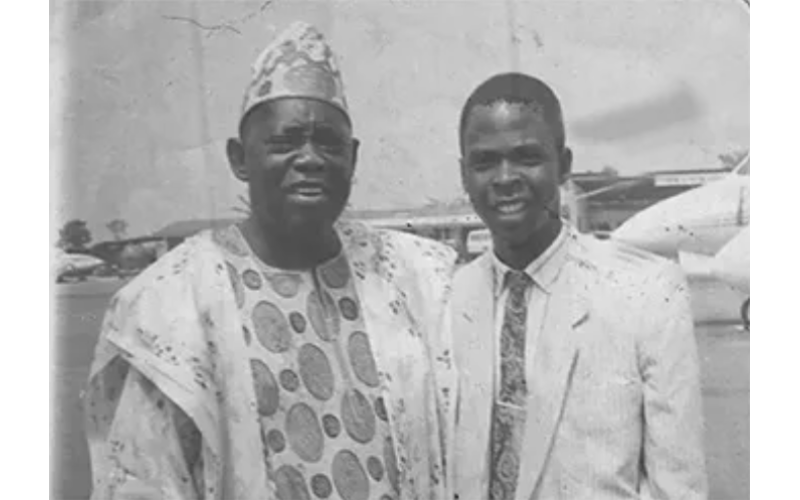
Today marks 32 years since the historic Nigerian
presidential election of June 12, 1993—an election widely regarded as the most
credible in the nation’s history. At its heart stood Bashorun MKO Abiola,
a towering figure in Nigerian public life whose legacy continues to resonate in
both politics and sports.
Despite widespread pre-election challenges—including
fuel shortages, a media blackout, and deliberate attempts to incite
unrest—Nigerians turned out en masse to vote, transcending ethnic, religious,
and social boundaries. Much of this unity was inspired by Abiola’s
unifying campaign, “Hope ‘93”, and the credibility he brought through
his pan-Nigerian identity, philanthropy, and deep-rooted support for
the masses.
One of his most enduring legacies was his lifelong
commitment to sports, often described as the “opium of the masses.” No
individual in Africa has been more closely associated with the advancement of
sports on the continent than MKO Abiola.
Africa’s Pillar of Sports
In 1980, the African Sports Journalists Union
(ASJU) awarded Abiola the unique title of “Africa’s Pillar of
Sports“—a distinction no one else has held since. His support for sports
was vast and pan-African, encompassing not just Nigeria but 14 other
countries, including Senegal, Côte d’Ivoire, Tunisia, and Zambia.
In January 1992, during a ceremony in Dakar,
Senegal, the Confederation of African Football (CAF) inducted Abiola
into its Hall of Fame, bestowing upon him its Order of Merit in Gold—CAF’s
highest honour. On that occasion, Abiola also donated and endowed the CAF
Cup trophy with $100,000, further solidifying his role as one of Africa’s
greatest sports philanthropists.
A Life Deeply Interwoven with Sports
Unlike many business and political leaders, Abiola’s
devotion to sports was unwavering. He sponsored events, clubs, and athletes
across various disciplines and countries. Yet, his foray into politics in the
early 1990s ultimately overshadowed his contributions to sports, cutting short
a golden era of private-sector support.
The annulment of the June 12 election by General
Ibrahim Babangida’s military regime set off a chain of political crises.
Abiola, who had won the election, was arrested and detained for over a year as
he insisted on his right to the presidency. He died in detention on July
7, 1998, under unclear circumstances.
It wasn’t until 2018 that June 12 was officially
recognized as Nigeria’s Democracy Day, replacing May 29.
January 11, 1993: The Quiet Prelude to
June 12
Before June 12 came January 11, 1993, a
lesser-known but significant moment in Nigeria’s political history—and in
Abiola’s personal journey.
I was part of MKO Abiola’s delegation to Abidjan,
Côte d’Ivoire, for the inaugural CAFSuper Cup match between Africa Sports
and Wydad AC of Morocco. The match, attended by CAF President Issa
Hayatou, was preceded by discussions about donating a new trophy on behalf
of President Babangida for the continental U-17 football tournament. The “Renaissance
Cup”, designed by Patrick Okpomo, was born.
Earlier, I had submitted the design for the CAF
Cup, which featured a gold-plated map of Africa on a stylised base—produced in
Germany, just like the Renaissance Cup. That night at Sofitel Hôtel Ivoire,
Okpomo and I were tasked with drafting a speech for Babangida’s formal
presentation of the trophy to CAF. When asked how much to include as the
president’s endowment, Abiola—true to form—quoted a Yoruba proverb: “You
can’t shave a man’s head in his absence.” He left the amount blank and
faxed the speech to the State House.
A Turn of Events in Abuja
Two days later, we boarded Abiola’s private jet
to Abuja with Hayatou and other Cameroonian officials. Also on board
were journalists Paul Bassey and Tony Nezianya (NAN). It
was my first visit to the Aso Rock Presidential Villa.
At the event, Babangida formally presented the
Renaissance Cup. But what followed shocked us: he announced the re-composition
of the Local Organising Committee(LOC) for the postponed 1995 FIFA U-20
World Cup and removed MKO Abiola as head of the Presidential Monitoring
Committee (PMC), replacing him with Major General Yohanna Kure.
Had Abiola fallen out of favour? We were left to
speculate.
After the ceremony, Abiola informed us of a change
in plans. Quoting another proverb—“When two logs fall on each other, you
attend to the one on top”—he instructed that travel arrangements be altered.
Dr. Doyin Abiola (his wife and Managing Director of Concord Press)
was to ensure CAF officials got to Dakar. Three days later, Abiola returned to
Lagos and declared his presidential ambition.
From Calabar to Barcelona: The Long Road
to Politics
Back in 1990, during the Nigeria
Universities Games (NUGA) in Calabar, I asked Abiola if he would
consider running for office again. He said his wife, Simbiat, a fellow
sports enthusiast, would never approve.
Her passing in 1992 marked a turning point. In light
of the repeated delays in the transition programme, I asked if he believed
Babangida genuinely intended to hand over power. Abiola replied with a cryptic
proverb:
“It’s like a man who claims he has no interest in a
woman but gets agitated when another man courts her.”
It was clear that he remained cautious, yet hopeful.
I recall another conversation during the
Barcelona 1992 Olympic Games, when the political climate in Nigeria was tense
and uncertain. Abiola remained a loyal interpreter of Babangida’s shifting
actions, always trying to make sense of the unfolding drama.
Legacy and Loss
Abiola’s death in 1998 shocked the world. Yet his
contributions to sports and democracy endure. For many, June 12 represents
not just a stolen mandate. It is also a national aspiration. Abiola remains its
most potent symbol.
In sports, his legacy remains unmatched. In politics,
he is remembered not just as a martyr of democracy. He is also remembered as a
man of vision, passion, and immense generosity.
Comments:
Leave a Reply