

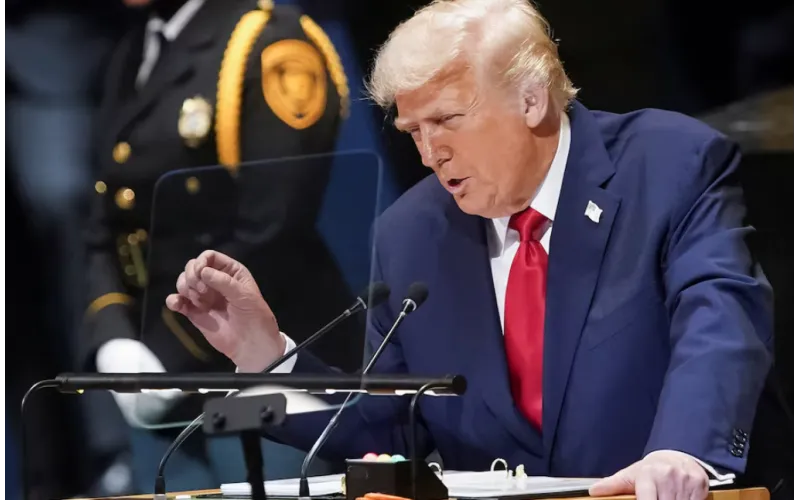
U.S. President Donald Trump has indicated that the
United States’ naval blockade on Iran could continue for several months,
describing it as a more effective strategy than military strikes to pressure
Tehran into abandoning its nuclear ambitions.
The announcement immediately rattled global markets,
pushing oil prices to their highest levels in over four years. Brent crude
climbed to $126.41, while West Texas Intermediate reached $110.31 before
slightly retreating.
Trump is expected to meet with Admiral Brad Cooper,
head of United States Central Command (CENTCOM), to evaluate further military
options. The command recently reported a “significant milestone,” stating that
it had successfully intercepted and redirected the 42nd commercial vessel
attempting to bypass the blockade.
U.S. officials estimate that at least 41 oil tankers
carrying roughly 69 million barrels of crude—valued at more than $6 billion—are
currently stranded, unable to be sold by the Iranian government.
Speaking to Axios, Trump described the impact of the
blockade in stark terms, claiming Iran’s economy is under severe strain and
warning that conditions could worsen further.
The blockade comes amid escalating geopolitical
tensions, with diplomatic talks between Washington and Tehran at a deadlock.
Vice President JD Vance recently cancelled planned trips to Pakistan aimed at
mediating the crisis, as uncertainty grows over Iran’s leadership dynamics
following reported Israeli strikes on senior officials.
Meanwhile, Vladimir Putin has cautioned the U.S.
against further escalation, warning of “damaging consequences” if military
conflict resumes involving both the U.S. and Israel. Trump has also threatened
to scale down American troop deployments in Germany after Chancellor Friedrich
Merz declined to back the blockade or support a proposed peacekeeping mission
in the Strait of Hormuz.
Global humanitarian concerns are also mounting. The
United Nations Development Programme has warned that the crisis, combined with
rising fertilizer costs, could push up to 30 million people worldwide into
poverty. Within Iran, the national currency has plunged to record lows,
deepening economic hardship for citizens.
Despite mounting pressure, Iranian Parliament Speaker
Mohammad Bagher Ghalibaf dismissed the blockade as an attempt to destabilize
the country from within.
Tensions remain high across the region, particularly
in Lebanon. Although a ceasefire is technically in place, the Lebanese military
has reported casualties from recent Israeli strikes, while a UN-backed
assessment indicates that more than 1.2 million people in Lebanon are facing
severe food insecurity due to the ongoing instability.
Comments:
Leave a Reply