

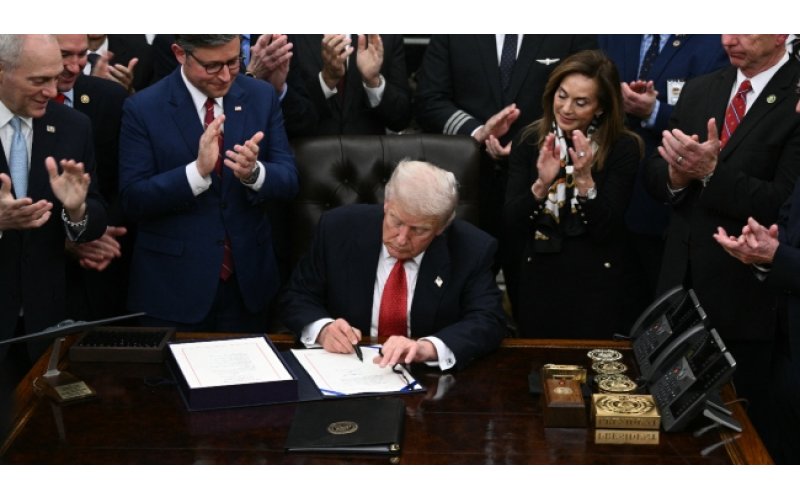
President Donald Trump on Wednesday signed into law a
bill ending the longest government shutdown in U.S. history — a 43-day standoff
that paralyzed Washington, left hundreds of thousands of federal employees
without pay, and deepened partisan divisions in Congress.
The Republican-controlled House of Representatives
voted largely along party lines to approve the Senate-passed funding package,
which reopens federal agencies and departments through January, with key areas
such as defense, veterans’ affairs, and agriculture funded through next fall.
Flanked by Republican lawmakers in the Oval Office,
including House Speaker Mike Johnson, Trump celebrated the bill’s passage as a
victory for his administration and accused Democrats of “extortion.”
“Today we are sending a clear message that we will
never give in to extortion,” Trump declared, urging Americans to “remember this
chaos” when voting in next year’s midterm elections.
Workers Return, Pay Restored
The agreement allows roughly 670,000 furloughed
civil servants to return to work and ensures back pay for another 670,000
essential workers who continued without pay, including air traffic
controllers and airport security personnel.
The bill also reinstates federal employees dismissed
during the shutdown and is expected to restore normalcy to air travel after
weeks of disruptions.
The Congressional Budget Office (CBO) estimates
the shutdown cost the U.S. economy $14 billion in lost growth — far
short of Trump’s disputed claim that Democrats’ actions cost the country $1.5
trillion.
Bipartisan Tensions and Political Fallout
House Speaker Mike Johnson blamed Democrats for
prolonging the shutdown.
“They knew it would cause pain, and they did it
anyway,” Johnson said on the House floor. “The whole exercise was pointless,
wrong, and cruel.”
Despite public polling showing most Americans blamed
Republicans for the impasse, the GOP appears to have regained footing following
the shutdown’s resolution.
Democrats, meanwhile, are grappling with internal
divisions. Party leaders had refused to reopen the government unless Trump
agreed to extend pandemic-era health care tax credits that made insurance
affordable for millions. However, a group of eight Senate moderates broke ranks
to strike a compromise, promising only a Senate vote on the subsidies — without
guarantees in the House.
Democrats in Disarray
The deal’s passage has sparked anger among
progressives who accuse Senate Majority Leader Chuck Schumer of capitulating.
Several House Democrats have privately called for new leadership, while party
figures eyeing the 2028 presidential race publicly denounced the agreement.
California Governor Gavin Newsom labeled the
deal “pathetic,” Illinois Governor JB Pritzker described it as an “empty
promise,” and former Transportation Secretary Pete Buttigieg called it a
“bad deal.”
Still, Democratic leaders insist their strategy
successfully elevated health care as a key campaign issue ahead of the 2026
midterm elections.
“We have elevated the Republican health care crisis —
and we’re not backing away from it,” said House Minority Leader Hakeem
Jeffries on MSNBC.
The Road Ahead
The compromise buys Congress a few months of
stability, but deeper policy disagreements remain unresolved — especially over
health care, spending priorities, and the federal deficit. With midterms
approaching, both parties now seek to leverage the shutdown’s outcome to rally
their bases.
Comments:
Leave a Reply