

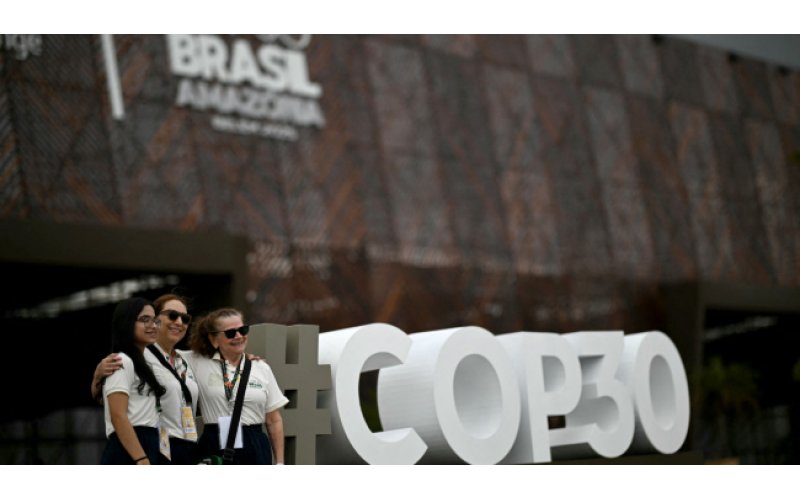
Belem, Brazil — World leaders are meeting Thursday in
the heart of the Brazilian Amazon to demonstrate that global action on climate
change remains a priority, despite unfulfilled promises and the absence of the
United States.
Roughly 50 heads of state and government are expected
to converge on Belem, a rainforest city of 1.4 million people, for the two-day
summit ahead of next week’s UN Climate Conference (COP) negotiations.
While nearly every nation will participate, Washington
is sending no delegation, with U.S. President Donald Trump dismissing climate
science as a “con job.”
Among those expected are UK Prime Minister Keir
Starmer and French President Emmanuel Macron, though major economies such as China
and India are represented by climate ministers and deputies.
Infrastructure Struggles in Belem
The choice of Belem as the summit venue has sparked
debate. Half of the city’s residents live in working-class neighborhoods known
as favelas, and limited infrastructure has pushed hotel prices to record
highs — hindering attendance by smaller delegations and NGOs.
Authorities have rushed to complete renovations, but
as of Wednesday, journalists and delegation teams arriving at the venue still
found construction underway.
Despite the challenges, locals expressed
optimism.
“The COP is bringing Belem the recognition it
deserves,” said Karol Farias, a 34-year-old makeup artist at the city’s
Ver-o-Peso market.
Uncertain Climate Momentum
Brazil, the host nation, says it does not expect major
breakthroughs at COP30 but hopes to reaffirm global unity on climate action
amid economic strain, wars, and growing backlash against green policies.
However, Brazil’s own recent approval of oil drilling
near the Amazon River’s mouth and the U.S. absence have cast a shadow over
proceedings.
Complicating matters, UN Secretary-General António
Guterres has acknowledged that the world is off track to meet the 1.5°C global
warming limit, warning that the target “will be missed.”
To aid low-income delegations struggling with high
costs, Brazil announced it had secured cruise ship cabins as free accommodation
for representatives from developing nations.
Push for Accountability and Climate
Finance
President Luiz Inácio Lula da Silva has framed the
summit as a call for implementation rather than new promises.
“Enough talking — now we have to implement what we’ve
already discussed,” Lula said earlier this week.
Brazil is championing the creation of a global fund to
reward tropical countries for protecting rainforests and is also emphasizing climate
adaptation, a long-standing demand of poorer nations vulnerable to rising seas
and natural disasters.
“This is not a charity, but a necessity,” said Evans
Njewa, Malawian diplomat and chair of the Least Developed Countries (LDC) bloc,
who called for concrete plans to boost climate finance to $1.3 trillion
annually by 2035.
Meanwhile, Greenpeace Brazil urged world leaders to
deliver “a clear and ambitious mandate” to close the emissions gap.
The Fossil Fuel Question
Despite growing consensus on the need to phase out
fossil fuels, deep divisions remain.
“For many of our countries, we won’t be able to adapt
our way out of something that overshoots two degrees,” warned Ilana Seid,
diplomat from Palau and chair of the Alliance of Small Island States.
Lula said Brazil plans to propose a “roadmap for
reducing fossil fuels”, though he admitted it would be “a difficult
conversation.”
Even if all current commitments are honored,
scientists project global warming could still reach 2.5°C by century’s end — a
trajectory experts warn would devastate vulnerable nations and ecosystems.
Comments:
Leave a Reply