

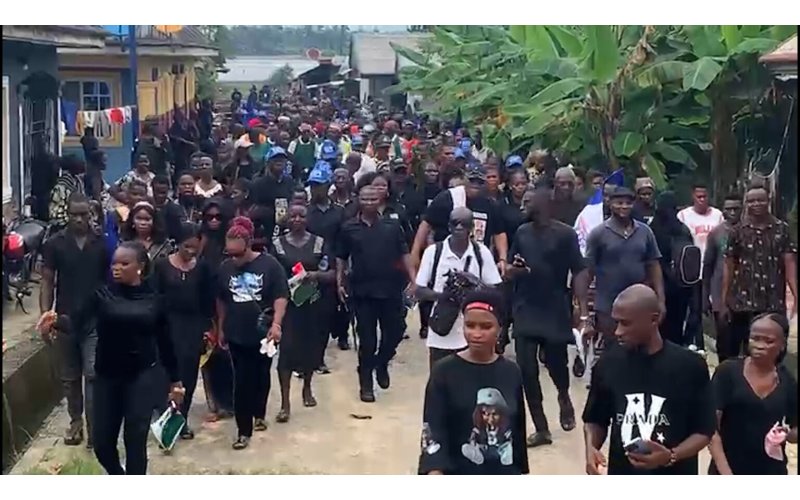
Thirty-one years after the execution of environmental activist Ken Saro-Wiwa
and eight others, the people of Ogoniland on Sunday gathered to honour
their memories and renew calls for justice and reconciliation.
Beyond remembering the Ogoni Nine, this year’s
commemoration also focused on the Ogoni Four — Edward Kobani,
Theophilus Orage, Samuel Orage, and Albert Badey — whose killings in Gokana
Local Government Area in 1994 preceded the arrest and execution of
Saro-Wiwa and his colleagues in 1995.
Across communities in Ogoni, various groups held
memorial events to mark the solemn anniversary. In Gokana, the Gokana
Unity Forum, Council of Chiefs, and families of the victims demanded
the retrieval of the remains of the four men allegedly murdered by a mob
outside the palace of the then Gbemene of Gokana.
The groups insisted that recovering and giving the
victims a dignified burial would mark a major step toward peace and true
reconciliation in Ogoniland.
“The time has come for the remains of Chief Edward
Kobani, Chief T.B. Orage, Chief S.N. Orage, and Chief A.T. Badey to be
recovered and returned to their families for dignified burial. That is the true
foundation of peace. Without truth and justice, reconciliation will remain a
mirage,”
— Chris Barigbon, Gokana Unity Forum representative
The Gokana Unity Forum also accused the Movement
for the Survival of the Ogoni People (MOSOP) of ignoring genuine
reconciliation efforts, alleging that the group planned to lay wreaths on
symbolic graves instead of working with stakeholders to recover the actual
remains — as recommended by the Oputa Panel in 2001.
President of the Forum, Goodluck Gbara-Age,
reaffirmed the community’s resolve, saying the younger generation would
continue to seek justice until the truth of what happened is fully addressed.
Former Minister of State for Industry, Trade and
Investment, Kenneth Kobani, whose father was among the Ogoni Four, spoke
emotionally about forgiveness and the need for truth.
“It’s been 31 years since my father and others were
brutally murdered here in Gokana. We had every reason to seek revenge, but we
chose forgiveness.
True reconciliation must begin with truth. You cannot deny what happened. These
men were killed in broad daylight, and the culprits were known,” he said.
Kobani expressed appreciation to President Bola
Tinubu for renewed efforts at reconciliation but warned against
politicising the Ogoni struggle.
“Ogoni wants peace, unity, and progress. We’ve seen
enough pain. We don’t hate anyone, but we must not be forced to bury our
fathers with empty caskets again,” he added.
Clad in black and carrying placards, mourners paid
courtesy visits to the King of Bodo and to the homes of the Badey
and Kobani families, offering prayers for peace and unity.
Meanwhile, the National Youth Council of Ogoni
People (NYCOP) held a separate memorial for Ken Saro-Wiwa and his
colleagues, describing them as “symbols of courage and sacrifice.” The youth
group thanked President Tinubu for the posthumous pardon granted earlier
this year but urged for a formal court exoneration and full
implementation of the Ogoni Bill of Rights.
They also decried what they called political
marginalisation, noting that no Ogoni indigene has ever served as governor
or deputy governor of Rivers State since its creation.
For the people of Gokana and Ogoniland, November
10 remains not just a memorial, but a renewed call for justice,
reconciliation, and inclusion — a reminder that the struggle for equality
and recognition continues until all voices are heard.
Comments:
Leave a Reply