

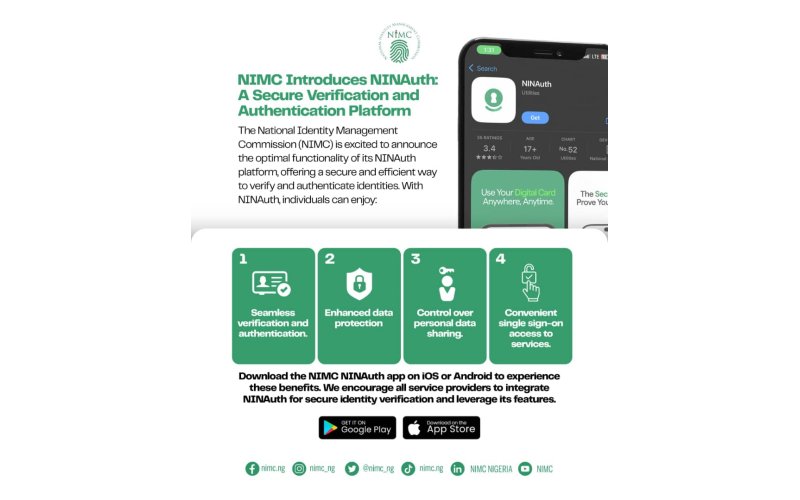
The National Identity Management Commission (NIMC) has
confirmed that all telecommunications operators in Nigeria have successfully
migrated to its upgraded National Identification Number (NIN) verification
platform, known as NINAuth. This marks a significant step forward in
strengthening Nigeria’s digital identity ecosystem and enhancing data privacy,
service efficiency, and user empowerment.
A Leap Toward Secured Digital Identity
Developed internally by NIMC, the NINAuth platform
replaces the older verification system and offers real-time NIN authentication
for SIM registrations, swaps, replacements, and number porting. The upgraded
system is designed to provide seamless, secure, and user-controlled identity
validation for telecom services.
Lanre Yusuf, NIMC’s Director of IT/Identity Database,
stated, “This milestone reflects our commitment to securing digital identity
and empowering Nigerians with greater control over their data.” He confirmed
that MTN, Airtel, Glo, and 9mobile are now fully integrated into the new
platform.
Dr. Kayode Adegoke, Head of Corporate Communications
at NIMC, added that NINAuth prioritizes user control, stating, “The goal
is to place control of identity data in the hands of the rightful owners—the
Nigerian people.”
System Migration Faced Hurdles
The transition to NINAuth, which began in late June
2025, was not without complications. Technical integration issues caused
significant disruptions to SIM-related services for over three weeks.
Subscribers were unable to register new SIMs, perform SIM swaps, or port their
numbers—prompting widespread frustration nationwide.
The Association of Licensed Telecommunications
Operators of Nigeria (ALTON) attributed the disruptions to unforeseen
integration challenges. ALTON’s Chairman, Gbenga Adebayo, criticized NIMC for
enforcing the migration without proper stakeholder consultation, calling it an
“ambush” that affected operations and consumers alike.
Consumer advocacy groups also voiced concerns, citing
the absence of a robust public sensitization campaign. Adeolu Ogunbanjo,
President of the National Association of Telecoms Subscribers, said,
“Everything is tied to NIN, and there’s no proper public education or
consultation.”
NIMC: Service Issues Now Telcos’
Responsibility
As the July 30, 2025, deadline for full activation
approaches, NIMC clarified that it will not be responsible for any ongoing
issues related to SIM registration or migration. “NIMC is not responsible for
any issues arising from new SIM registration, SIM swap, or SIM migration,”
Adegoke explained. The agency urged subscribers to contact their respective
service providers directly for resolution.
Why NINAuth Matters
NINAuth is a core component of Nigeria’s broader
digital identity reform strategy. Since the Federal Government’s mandate
linking SIM cards to NINs in 2020, over 125 million SIMs have been linked. A
similar enforcement action in April 2022 led to over 72 million subscribers
being barred from making calls, highlighting the policy’s weight.
The NINAuth platform introduces tokenisation, a
feature that enhances privacy by requiring user authorization for each
verification request. Unlike the previous system, which allowed background
verification without user knowledge, NINAuth ensures full transparency and data
ownership.
It also includes Application Programming Interfaces
(APIs) for integration across sectors such as banking, immigration, and
education, and is backed by NIMC’s renewed partnership with IDEMIA Smart
Identity to boost biometric security.
Looking Ahead
Despite initial setbacks, the successful migration to
NINAuth lays the foundation for a more robust, secure, and transparent digital
identity infrastructure in Nigeria. With all telcos now integrated and services
gradually returning to normal, subscribers can expect improved identity
verification and reduced data misuse.
Industry observers, however, warn that continued
progress will depend on stronger stakeholder collaboration, more public
education, and a commitment to balancing national security with user privacy.
Comments:
Leave a Reply