

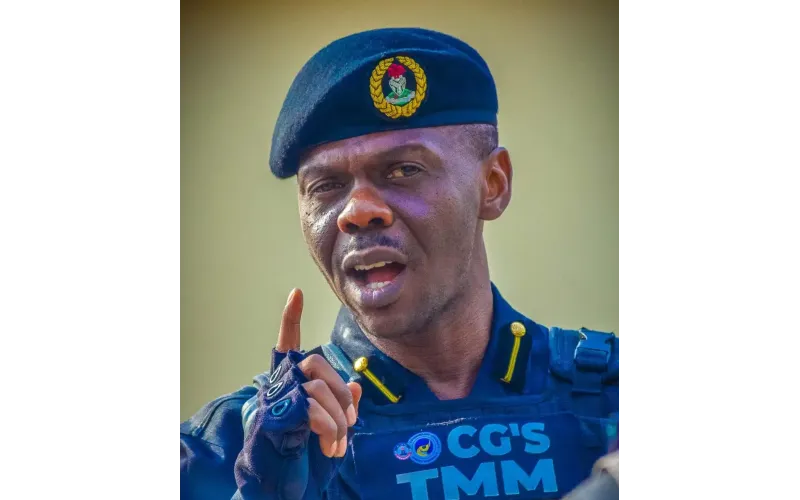
Attah John Onoja’s tenure as Commander of the NSCDC
Special Mining Marshals stands as a rare instance where public service,
integrity, and measurable impact converge. Tasked with the daunting
responsibility of confronting entrenched illegal mining cartels, he has
delivered results that are both quantifiable and morally resonant. This is not
about vague “efforts” or hollow “sensitisation campaigns.” It is about a
concrete record of arrests, recovered sites, and an unwavering refusal to yield
to bribery or political pressure.
The facts speak for themselves. Federal records reveal
that in just 14 months, the Marshals under Onoja’s watch identified 460 illegal
mining sites, arrested 387 offenders, and recovered 99 sites for licensed
operators. Other credible tallies suggest even higher achievements — over 400
arrests, 152 prosecutions, and 599 identified sites. Whichever way the numbers
are tallied, they represent enforcement on a scale Nigeria’s mining sector has
not witnessed in years. These actions disrupt the lifeblood of criminal
networks, protect the environment from devastating degradation, and reclaim
resources for the nation’s legitimate economy.
Yet, it is not merely the statistics that make Onoja
remarkable — it is the manner in which he achieved them. In a sector awash with
illicit cash and backdoor deals, multiple attempts have been made to compromise
him. Each time, the outcome has been the same: a polite but resolute refusal.
In a country where too many enforcement campaigns have collapsed under the
weight of “settlements,” Onoja’s non-negotiable stance serves as both a
deterrent to offenders and a source of inspiration for honest officers.
This calibre of leadership thrives best when nurtured
by a principled superior. Onoja’s record is inseparable from the vision and
support of his principal, the Commandant General of the NSCDC, Professor Ahmed
Abubakar Audi. Audi is not content with ceremonial leadership; he has fortified
the Mining Marshals with clear operational procedures, expanded their manpower
from about 2,220 to 2,670 in a single year, modernised their training, and
advanced the adoption of surveillance technologies — from drones to satellite
monitoring systems. Crucially, he has shielded them from undue interference,
allowing competent commanders like Onoja to act with precision and authority.
Recognition has also come from the highest level
within the sector. Nigeria’s Minister of Solid Minerals, Dele Alake, has
publicly commended Onoja for his uncompromising war on illegal mining. His
praise is not ceremonial; it reflects the ministry’s direct gains from Onoja’s
enforcement — more legally operated sites, improved compliance among licensed
operators, and a clear message that illegal extraction will face swift
consequences. When the sector’s minister publicly endorses a security
commander’s work, it is both a validation and a call to intensify the fight.
Of course, such a campaign has not been without
turbulence. The Mining Marshals have encountered inter-agency tensions,
community pushbacks, and legal battles — including defamation suits by Onoja
against those intent on tarnishing his name. But these are not signs of
failure; they are the predictable resistance faced when dismantling lucrative
criminal enterprises. Friction, in this context, is proof of impact.
The lesson is clear: effective law enforcement is
never the result of a single man’s will. It emerges from the convergence of
integrity, institutional strength, and political resolve. In Onoja, Nigeria has
a commander who refuses to be bought. In Professor Audi, the NSCDC has a
reformist leader who equips and empowers his officers. And in Dele Alake, the
sector has a minister willing to publicly applaud decisive action. This
alignment is rare — and precious.
If history is fair, it will remember Attah John Onoja
not just as the man who proved that illegal mining can be confronted without
compromise, but as one who operated under a Commandant General who gave him the
tools and freedom to succeed, and with the public backing of a minister who
recognised that courage must be met with sustained support. This is the kind of
synergy Nigeria needs — not only in mining but across every sector where
integrity is tested and national interest is at stake.
Usman Haliru writes from Gusau, Zamfara State.
Comments:
Leave a Reply