

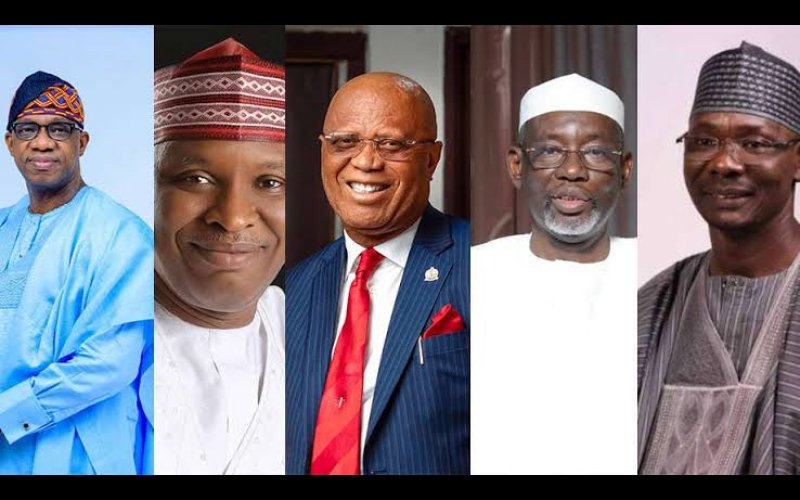
Fresh findings have revealed that 29 state governors
spent N79.97bn on domestic and international travel expenses between January
and June 2025.
This made the financial prudence and spending
discipline of state governors come under intense public scrutiny, sparking
renewed outrage and concern over what many describe as a growing culture of
fiscal irresponsibility amid mounting debts and underwhelming revenue
generation across the states.
An analysis of the fiscal performance of each state,
utilising data from the Q1 to Q2 budget performance reports obtained from each
state’s website, revealed a pressing need for stringent measures to prioritise
fiscal discipline, especially amidst growing calls to reduce the costs of
governance, rising hardship among citizens, dwindling internally generated
revenues, and an overwhelming dependence on statutory allocations from the
Federation Account.
The latest figure marks a 14.72 per cent increase
compared to the N69.71bn spent on travel expenses by governors within the same
period in the 2024 fiscal year.
Despite the costs, only Lagos, Ogun, Oyo, Kaduna,
Kano, and Ekiti states attracted capital importation from foreign investors in
the first quarter of 2025, according to the National Bureau of Statistics in
its Capital Importation report for Q1, 2025. The agency is yet to publish
results for the second quarter.
According to the report, only five states and the
Federal Capital Territory recorded foreign capital inflows during the review
quarter.
The FCT emerged as the top destination, attracting
$3.05bn, which accounted for 54.11 per cent of the total capital imported.
Lagos State followed closely with $2.56bn or 45.44 per
cent, while Ogun State received $7.95m (0.14 per cent). Other beneficiaries
were Oyo with $7.81m, Kaduna with $4.06m, and Kano, which trailed with just
$120,000.
The implication is that 31 states failed to attract
any form of capital importation during the period under review, despite
collectively spending billions of naira in public funds on local and foreign
trips purportedly aimed at driving investment. This stark disparity has further
intensified scrutiny of the cost-benefit value of such expenditures by state
governments.
A cursory review of the budget implementation report
revealed that only 26 states have published their financial records for both
the first and second quarters of the year. Benue, Lagos, Delta, and Katsina
have so far released only their Q1 reports, while Akwa Ibom, Enugu, Ogun,
Rivers, and Plateau are yet to make any financial records public for the period
under review.
An analysis of the state-by-state breakdown of travel
expenses revealed significant disparities in the amount spent by governors on
local and foreign trips, with some states spending more than double the amounts
recorded by others within the same period.
Lagos State, Nigeria’s commercial capital, recorded
the highest expenditure, with a staggering N6.23bn spent in the first quarter
of 2025 alone. It was closely followed by Osun State, which recorded N6.21bn,
and Kano State, which spent N5.58bn, placing it as the highest spender in the
North.
Also ranking among the top spenders were Taraba State,
which spent N5.22bn, and Bayelsa, which committed N3.78bn to travel-related
expenses. Ekiti (N3.76bn), Borno (N3.68bn), and Cross River (N3.68bn) also
maintained high spending profiles, alongside Yobe (N3.70bn) and Edo (N3.51bn).
In the North-East, Adamawa spent N2.24bn, while Bauchi
recorded N3.66bn. Gombe spent N1.20bn, and Yobe committed N3.70bn. Borno State
matched Cross River’s figure with N3.68bn. From the North-Central, Niger State
incurred N2.63bn in travel costs, while Nasarawa and Benue reported N2.24bn and
N1.13bn respectively, with Benue’s figure reflecting only Q1 expenditure.
Kogi and Kwara recorded N1.75bn and N1.2bn,
respectively. In the South-East, Abia spent (N1.03bn), Ebonyi (N1.45bn), and
Imo (N928.34m). Enugu and Anambra states had not published their expenditure
reports for the year at the time of this report.
For the South-South region, Bayelsa led with N3.78bn,
followed by Cross River (N3.68bn) and Edo (N3.51bn). Delta State reported
N884.81m in Q1 alone, while Akwa Ibom and Rivers had not made any financial
disclosures for the period under review. Kebbi and Sokoto in the North-West
reported N1.53bn and N2.59bn respectively, while Zamfara recorded N2.77bn.
Jigawa spent N1.26bn, Kaduna (N1.86bn), Kano (N5.58bn), and Katsina (N548.24m)
in Q1.
In the South-West, Osun and Ekiti led with N6.21bn and
N3.76bn respectively. Ondo spent N1.83bn, Oyo (N1.89bn), and Lagos N6.23bn in
Q1. Ogun State is yet to publish its financial report. Notably, Delta, Benue,
Katsina, and Lagos only published their Q1 records, meaning their actual annual
travel expenses may be significantly higher.
A geopolitical analysis of the expenditure revealed
that South-West governors were the biggest travellers, accounting for N19.92bn
or 24.9 per cent of the total amount spent, even though only four of the six
states in the region had available data.
The North-West states followed closely with N17.58bn
(22 per cent), while the North-East region recorded N13.92bn (17.4 per cent) in
travelling expenses. In the South-South region, state governors collectively
spent N11.81bn, representing 14.8 per cent of the total travel expenditure.
The North-Central region governors spent a total of
N10.79bn, accounting for 13.5 per cent of the overall spend. In the South-East,
travel expenses stood at N5.94bn, amounting to 7.4 per cent of the total.
The wide-ranging figures have continued to raise
concerns about fiscal discipline and value-for-money in governance,
particularly in states battling infrastructure deficits. At different fora,
financial experts have also raised concerns about states’ spending on recurrent
expenditure, highlighting the need to embrace financial innovations.
Recently, President Bola Tinubu urged state governors
to prioritise Nigerians’ welfare by investing more in their future, putting
more money into rural electrification, agricultural mechanisation, poverty
eradication, and improved infrastructure investment.
Tinubu implored the governors to do more to positively
impact the lives of Nigerians in the grassroots, saying, “I want to appeal to
you; let us change the story of our people in the rural areas. The economy is
working. We are on the path of recovery, but we need to stimulate growth in the
rural areas. We know the situation in the rural areas, let us collaborate and
do what will benefit the people.”
Tinubu urged state governors to collaborate with the
Federal Government to drive economic development in rural areas nationwide. “We
have to embrace mechanisation in agriculture, fight insecurity, and improve
school enrolment through feeding,” the President said.
The President’s comment received backing from the
Chief Executive Officer of the Centre for the Promotion of Private Enterprise,
Muda Yusuf, who, in an interview with our correspondent, described the position
as timely and necessary for restoring fiscal discipline and economic
confidence.
He said, “Recently, President Bola Tinubu told state
governors about the impact of the revenue windfall and asked them to ensure
that the benefit of increased revenue trickled down to the lowest strata of
society,” he said.
“He said there was a complaint from the grassroots
that they are not feeling the effect. He urged the governors to do more, which
means it is something the president also recognises.”
Yusuf emphasised that governors must look beyond urban
infrastructure and prioritise inclusive development across all regions within
their states. “Governors should not only concentrate development in the state
capital, but also spread development to other locations within the state. Those
monies should not just be spent on flyovers, roads, and airports in the capital
city,” he said.
“They should look for other projects they can do in
other parts of the state and see what development they can bring.”
Commenting in an earlier interview, A professor of
Economics at Babcock University, Segun Ajibola, stated that the enduring
problem of high governance expenses had persisted at the state level, with
inadequate oversight and accountability resulting in minimal economic benefits
for grassroots citizens.
Ajibola, a former president of the Chartered Institute
of Bankers, lamented that state assemblies had also abandoned their oversight
duties, leaving the state governors to operate with no iota of transparency and
accountability.
Similarly, an ECOWAS Common Investment Market
consultant, Professor Jonathan Aremu, highlighted that most states don’t have
attractive factors.
“It’s because they don’t have attractive factors. The
factors that attract foreign investment are not available in those states. One
thing about investment is that it is crisis shy. Investment doesn’t go to
places where there are crises. Because investors want stability and
predictability in their investments, particularly, having returns on their
investments”, he added.
Comments:
Leave a Reply