

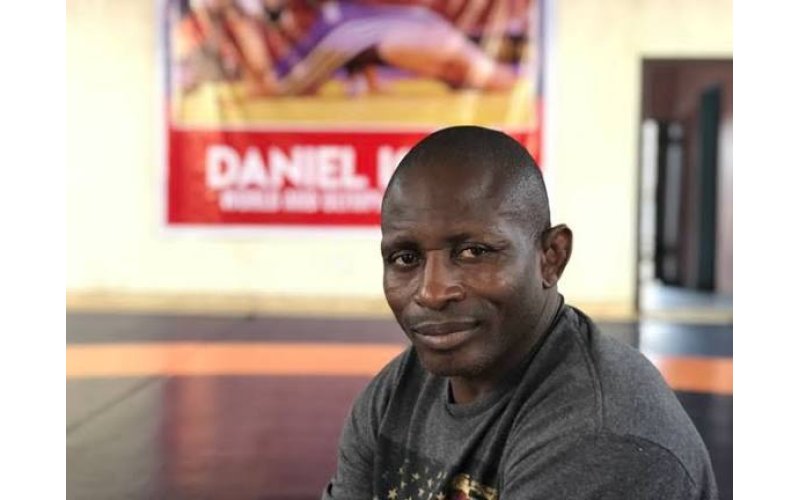
Before he became an Olympic champion, Daniel Igali
was just a boy in Bayelsa, wrestling barefoot in the sand and dreaming of one
day flying on an airplane. Wrestling gave him that chance—and ultimately took
him to Sydney 2000, where he made history as Canada’s first Olympic
wrestling gold medalist.
For Igali, wrestling was more than a sport. In his
village, it was a badge of honor. “The people you respected the most in town
were the wrestlers,” he recalls. Like many boys, he tussled after school in
local arenas, often returning home with a dirty uniform to his mother’s
disapproval. His mother, a teacher, wanted academics to take precedence, while
his father, a chartered accountant, hoped for a more conventional path.
Yet by age 10, Igali was already dominating older
boys. That same year, an Olympian who had competed at Los Angeles 1984 visited
and spoke of traveling abroad for competitions. For the young boy who thought
Egypt was in heaven because of Bible stories, the idea of flying to another
country was transformative.
“I wanted to go to the Olympics because I thought that was the only way to fly
by plane,” he says with a smile.
Despite his passion, Igali excelled in academics,
earning admission to the University of Jos at 17. But financial
constraints and the demands of international competitions forced him to juggle
delayed exams and missed lectures. Once, his coach even pleaded with lecturers
to allow him to sit for rescheduled papers.
In 1991, fresh out of secondary school, Igali earned
his first national team call-up for the All-Africa Games in Cairo. It
was his first plane trip, his first time abroad—and he returned home with a
silver medal, instantly becoming a local hero. But heartbreak soon followed. At
the 1992 Olympic qualifiers, with athletes sleeping at Lagos airport and
starving themselves to make weight, Igali’s name was left off the final travel
list. “That was the biggest disappointment I ever had as an athlete,” he
recalls.
By the mid-1990s, Igali had relocated to Canada to
study and train. Though his heart remained tied to Nigeria, repeated
setbacks—including being denied a place at the 1996 Olympic trials and the 1997
World Championships—made him reconsider. By 1998, when he became a Canadian
citizen, he decided to switch allegiance.
“By then, it was a no-brainer,” he explains.
Canada embraced him fully—not only as an athlete but
also as a leader, coach, and teacher. And in Sydney 2000, Igali delivered.
Wrestling through the men’s freestyle 69kg category, he claimed Canada’s
first-ever Olympic wrestling title. His iconic celebration—kneeling on the
mat, wrapped in the Canadian flag, and kissing it—remains one of the most
enduring images of Olympic spirit.
Yet Bayelsa and Nigeria have never left his heart.
Today, Igali continues to bridge both worlds: mentoring young athletes,
advocating for sports development, and pushing for better structures to support
student-athletes in Nigeria.
“I’m glad everything worked out well,” he reflects. “If not for what Canada did
for me, I wouldn’t be where I am today. But I’ve also been able to give back to
Nigeria.”
From the creeks of Bayelsa to the global stage of
Sydney, Daniel Igali’s journey is one of resilience, sacrifice, and vision. It
is proof of what can happen when raw talent meets opportunity—and when a dream
born in the sand finds expression on the world stage.
Comments:
Leave a Reply