

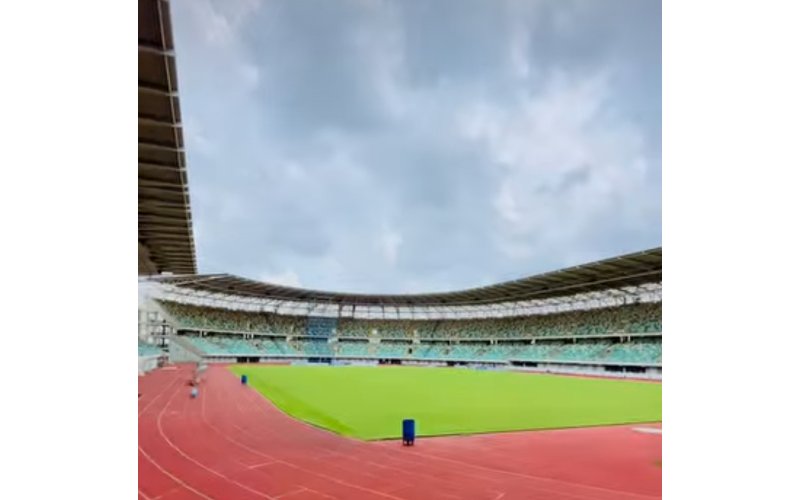
Why is it that it is only Uyo, a small, laid back
emerging metropolis located in the southernmost part of Nigeria, that has the
only stadium facility with FIFA’s approval to host Nigeria’s Grade A
international matches?
It is ridiculously unbelievable, yet it is true. With
Nigeria’s records of achievements and football, no other stadium in the country
can host the highest levels of football!
The answer to that question is very simple, too simple
to be true. In fact, it is so elementary that, for a country with Nigeria’s
reputation as a football-crazy nation, it is shameful.
The answer is not rocket science.
It is the grass. The flat, lush, beautiful,
well-manicured, green grass on the surface of that magnificent stadium in Uyo
that stands out majestically from the rest of the stadia around Nigeria.
Even the MKO Abiola National Stadium in Abuja, the
Federal Capital City, the most beautiful and most modern sports complex in the
whole of Africa, is ‘dead’ of major activity, even beyond football, because the
surface where the big football matches is not good enough.
Ironically, it is the presence of these big matches,
hosted here, that can impact, enliven and transform the entire sports complex
into a social hub for all sports followers in Abuja.
The grass field is that important and that powerful in
the football eco-system. The simple fact, most often underrated, is that it is
the grass turf that rules. It is everything in football. Nothing else compares,
and nothing can be an alternative. It is as simple as that.
It may not be easy for the ordinary person, ungrounded
in football played at the highest levels in personal experience, to fully
appreciate it and understand the complex connections that the grass on a
football field has with the entire football experience, the entire industry,
the players’ complete development, the serious followership, the fanatical
crowds, the best television coverage, and attractive sponsorship opportunities.
Even the magnitude and severity of injuries that players suffer on the field of
play is d terminus by the quality of turf used in a game. That’s why for
example, no amount of insurance money will make a Messi, a Ronaldo, and that
level of players to accept to come and play in Nigeria outside Uyo, today!
That’s probably why Nigerians never got the
opportunity to watch Kanu Nwankwo, Jay Jay Okocha, Victor Ikpeba and a whole
legion of other great professional players to return home to play out the
evening of their careers in domestic Nigerian football.
The existing football fields for matches will render
them ineffective, optically worse than even the good players in the present
domestic league that may never rise to become greats.
That’s why foreign coaches handling the national team
don’t find players in the domestic leagues good enough.
Wrong grounds and bad surfaces, breed less effective
players. Bad grounds render coaching and training sessions less effective. Bad
grounds make for poor viewing both from the terraces and on television. Bad
grounds make manipulation of matches by referees easier.
I often appear to be a lone voice on this subject. The
only other voices are silent whispers that are partners in the business of
selling alternative poor products, and using fancy words and ‘FIFA approvals’
to make big business of selling their products.
Synthetic and hybrid surfaces are good, but limited in
their use in football with ambition to be the amongst the best in the world.
These fields do not take the business of football or the game itself to the
highest levels.
Incidentally, things were not always the way they are
now.
30 years ago, the destruction of the most important
single ingredient in the development of football as a business, football as a
beautiful game, and footballers as the prime actors in the game, started.
The most powerful of those heading the sports sector
at the time in Nigeria were neither grounded in the football game nor in its
administration.
They came into power, and with their limited
knowledge, vision, experiences and understanding embarked on ‘renovations’ of
facilities that ended in the destruction of Nigeria’s football grass fields.
Since then the domestic game of football has
floundered and has not been the same again.
The excavation and replacement of the grass turfs on
the grounds of the National Stadium in Lagos, Liberty stadium, Ibadan, Ahmadu
Bello Stadium, Kaduna, Nnamdi Azikiwe Stadium, Enugu, and, later, the Township
Stadium, Calabar, ostensibly with better turf, led to the start of the
destruction of the football industry in Nigeria! The ‘disease’ spread to
Bauchi, Lagos, Ogun, and other States.
This is not a small or flippant statement to make, and
the facts bear me out. All the listed stadia have stopped being venues for big
international matches, their other sports infrastructure have become infected
and have become carcasses. European clubs that used to come to Nigeria for
pre-season training (believe me that happened in our history) and also for
friendly matches, stopped coming. The various stadia that used to host
international Grade A football matches could not hold them any more.
The stadia started a slow and steady deterioration
that has now left them in bad shape, idle and shadows of themselves, with only
sweet memories of the past to remind us that we once enjoyed terrific football
matches on the hallowed grounds, and that the stadium complexes that can no
longer host big time matches are now like big barren trees that can no longer
bear fruits.
For 30 years, despite the best effort of successive
administrations, Nigeria has stumbled and fumbled fruitlessly to build a solid
football industry in the country. The crowds will not return in huge consistent
numbers to venues. Corporate sponsors are not attracted as they once were to
the domestic leagues with stadia filled to capacity from match to match around
the country. Domestic television coverage disappeared when the leagues on
TV became so unattractive to the viewer that no one could bear the ugliness of
the pictures being churned out as football on TV – poorly packaged products
competing with the well-packaged options from the Europe.
The Nigerian league could not produce players
exceptional enough to play directly in the national team without going abroad
first for some honing and transformation.
Why do retiring Nigerian professional players from
leagues in Europe not find Nigerian football comfortable enough to return to at
the end of their careers, even as that is the established culture in Europe and
South America?
Why are sponsors not falling over each other to put
their resources behind sponsoring the leagues?
Why do foreign coaches not find local players good
enough to play directly in the national team?
All these questions have been begging for answers for
30 years.
Last week, I went to watch some trial matches
somewhere in Lagos. Some foreign scouts were on a scouting expedition to
Nigeria.
After watching 4 teams of players, I gave up and left.
There was not a single player that displayed any exceptional talent. They were
all good players running around and trying hard to impress without success. It
was frustrating to watch.
The synthetic ground, newly laid and looking beautiful
from a distance, crippled the players. It appears I was the only one that
appreciated what was going on. So, I left in tears hidden behind my eyes.
Played on flat green lush grass, the game and the same
players would have been completely different! We would see them express
themselves better and be able to gauge their true potentials.
That’s it! The most important single ingredient in
football, in the development of players, in the evaluation of players, in
eye-friendly coverage on television, in developing meaningful team tactics and
strategies, in making the game attractive to play and to watch for spectators,
in pure undiluted football entertainment, in reducing the tendency for serious
injuries, is the surface on which football is played.
Nothing beats the green, rich, lush green grass!
That’s what makes the difference, what elevates the game to the highest level
in training and matches, what brings the spectators to watch spectacles, and
what draws sponsors like bees to nectar.
Comments:
Leave a Reply