

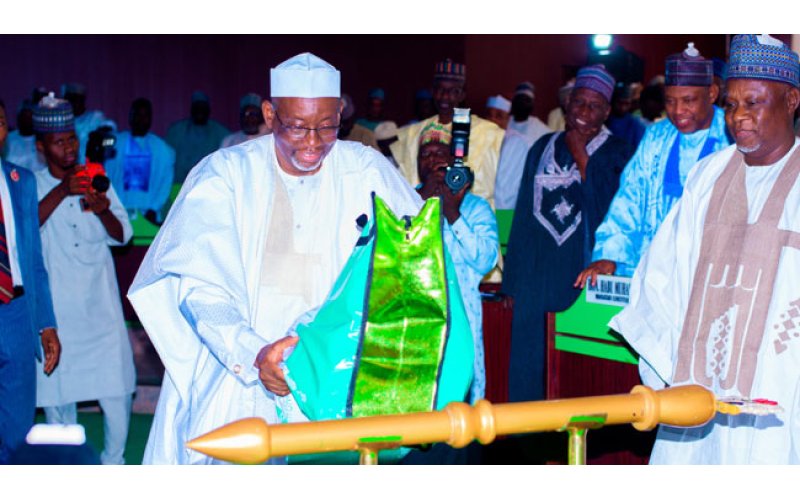
Jigawa State Governor, Umar Namadi, has presented a
proposed N901.8 billion budget for the 2026 fiscal year to the State
House of Assembly, describing it as an ambitious yet achievable roadmap to
sustain the administration’s long-term development vision.
Titled “Budget of Innovation & Transformation
for Greater Jigawa II,” the proposal represents a 19.2% increase
over the 2025 appropriation and is anchored on the newly approved third edition
of the Jigawa State Comprehensive Development Framework, built around
the government’s 12-Point Agenda.
Inclusive, Infrastructure-Driven Growth
Governor Namadi said the 2026 plan will sustain the
policy direction of the current fiscal year, emphasising inclusive,
human-centred economic growth.
“Our major focus will be the pursuit of inclusive and
human-centred economic growth, leveraging agriculture, SMEs, and critical
infrastructure,” he told lawmakers.
Revenue & Expenditure Structure
The N901.8bn budget will be financed through multiple
revenue channels:
On the expenditure side, capital projects dominate
with N693.4bn, about 77% of the total budget—one of the highest
capital-to-recurrent ratios in the state’s history.
According to the governor, this distribution ensures
strong investment in the state’s 12-point development priorities, including
infrastructure, agriculture, human capital, and youth empowerment.
Key Sector Allocations: Roads,
Agriculture, Education Lead
Roads and Transportation
received the single largest capital allocation at N186.37bn, covering
over 60 regional roads, 20 township roads, and several feeder roads across all
27 LGAs. New township roads will begin in Hadejia, Basirka, Gantsa, Buji, and
Garun Gabas, among others. Major new regional routes such as Kafin
Hausa–Gafasa–Jabo and Guri–Margadu will also commence.
Agriculture and livestock development
follows with N74.98bn, reflecting the state’s drive for food security,
mechanisation, enhanced irrigation, and expanded livestock productivity.
“These investments demonstrate our unwavering
commitment to economic diversification and prosperity for all citizens of
Jigawa State,” Namadi said.
The power sector gets N50.7bn, largely
for renewable energy expansion, solarisation of institutions, and rural
electrification.
Education and Health
jointly receive over N310bn, accounting for more than one-third of the
total budget. Education alone takes up over 26%—a share that surpasses
global standards.
Other notable allocations include:
Youth Empowerment & Social
Intervention
Youth empowerment initiatives take N12.7bn,
covering skill acquisition centres, microcredit schemes, women’s enterprise
support, and agro-processing equipment leasing.
“Our goal is to foster entrepreneurship and create
massive opportunities for youth and women,” the governor said.
Local Government Councils
Local government councils will operate with a combined
budget of N288.8bn, comprising:
LGAs will also expand mass housing projects, introduce
greenhouse and dry-season farming programs, and strengthen Tsangaya education.
Call for Swift Passage
Governor Namadi urged lawmakers to thoroughly
scrutinise the proposal but ensure timely approval.
“I kindly request an expeditious approval and passage
of the 2026 Appropriation Bill,” he said, reaffirming his administration’s
commitment to transparency, accountability, and participatory governance.
The governor concluded with prayers for peace and
continued progress.
“Long live Jigawa State; long live the Federal
Republic of Nigeria,” he declared.
Comments:
Leave a Reply