

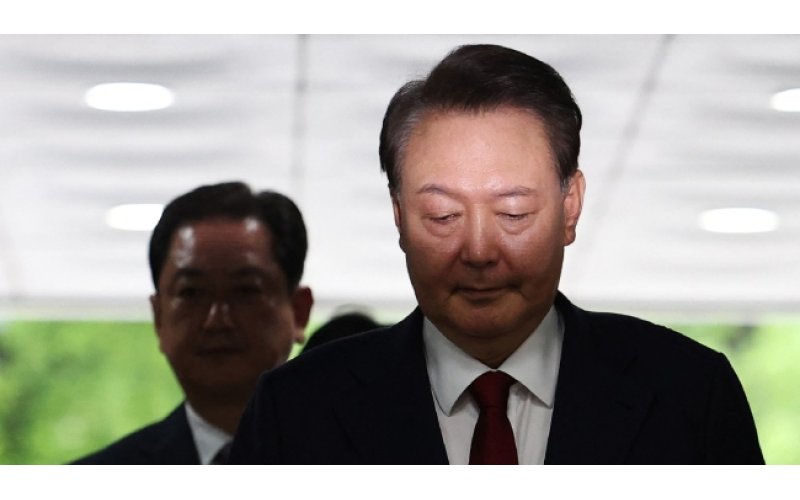
A Seoul court has sentenced former South Korean
president Yoon Suk Yeol to life imprisonment for insurrection following his
controversial declaration of martial law in December 2024.
Yoon, 65, had stunned the nation when he interrupted
late-night television programming on December 3, 2024, to announce the
suspension of civilian government, citing the need to eliminate “anti-state
forces” within the National Assembly and counter alleged North Korean threats.
The move triggered immediate political turmoil.
Lawmakers rushed to the assembly complex, barricading doors with furniture to
block armed troops. Martial law was lifted just six hours later after an
emergency parliamentary vote.
Presiding judge Ji Gwi-yeon of the Seoul Central
District Court ruled that Yoon deployed troops in an attempt to silence
political opponents who had obstructed his governance.
“The court finds that the intention was to paralyse
the assembly for a considerable period,” the judge said, adding that the
declaration of martial law imposed “enormous social costs” and that Yoon had
shown little remorse.
Under South Korean law, insurrection carries only two
possible penalties: life imprisonment or death. Although prosecutors had pushed
for the death penalty, South Korea has maintained an unofficial moratorium on
executions since 1997, making a death sentence effectively life behind bars.
Former Officials Also Jailed
Former defence minister Kim Yong-hyun was sentenced to
30 years in prison for his role in the crisis. Yoon had already received a
separate five-year sentence on lesser charges, while several senior officials
are facing lengthy prison terms.
Yoon has consistently denied wrongdoing, insisting he
acted to “safeguard freedom” and counter what he described as an
opposition-driven “legislative dictatorship.” Prosecutors, however, accused him
of orchestrating an insurrection fueled by a “lust for power aimed at
dictatorship and long-term rule.”
Protests and Security Clampdown
Thousands of Yoon’s supporters gathered outside the
courthouse ahead of the verdict, waving placards reading “Yoon Great Again” and
calling for charges to be dropped. Heavy police presence surrounded the court
complex, with buses forming barricades to prevent unrest.
The crisis has revived painful memories of the
military coups that shook South Korea between 1960 and 1980, casting a shadow
over a country long regarded as a model of democratic stability in Asia.
Meanwhile, Yoon’s wife, Kim Keon Hee, was sentenced
earlier in January to 20 months in prison on separate bribery-related charges
dating back to her time as first lady.
Yoon remains in solitary confinement as he continues
to fight multiple criminal cases stemming from the failed martial law attempt.
Comments:
Leave a Reply