

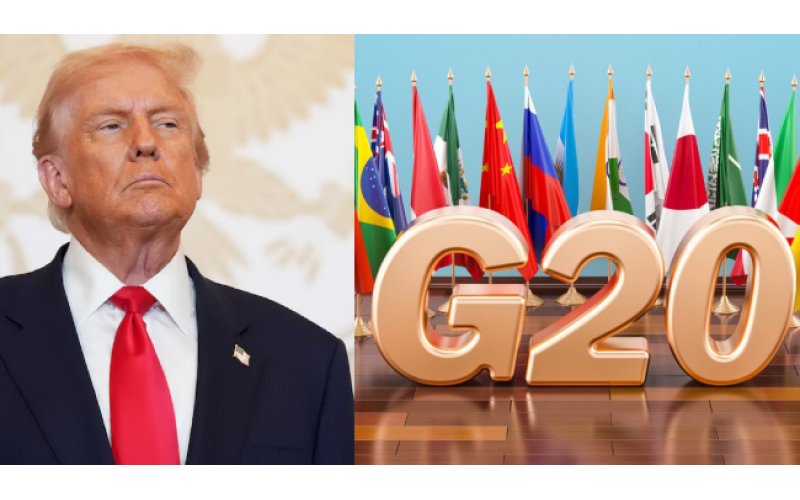
A deepening rift between the United States and its
European allies over the future of Ukraine is poised to overshadow the G20
summit opening in Johannesburg, South Africa, on Saturday. The gathering is
further marked by the pointed absence of US President Donald Trump.
The summit, the first G20 leaders’ meeting hosted on
African soil, brings together influential figures including French President
Emmanuel Macron, Indian Prime Minister Narendra Modi, Chinese Premier Li Qiang,
Brazilian President Luiz Inacio Lula da Silva, and Turkish President Recep
Tayyip Erdogan.
But Washington’s decision to boycott the
meeting—claiming South Africa’s priorities on global trade reform and climate
cooperation conflict with US policy—has dominated conversation around the
event.
Trump’s influence remained palpable despite his
absence. His administration recently unveiled a unilateral peace plan for
Ukraine that aligns closely with several of Russia’s demands, catching European
leaders off guard.
After an urgent call with Ukrainian President
Volodymyr Zelensky, Macron, German Chancellor Friedrich Merz, and UK Prime
Minister Keir Starmer jointly insisted that any peace proposal “must have the
backing of European partners and NATO allies.”
European leaders are expected to meet on the summit
sidelines to reinforce that “there should be nothing about Ukraine without
Ukraine,” according to European Commission President Ursula von der Leyen. She
added that a follow-up session will be held during the AU–EU summit in Angola
early next week.
Meanwhile, Trump warned Ukraine that its window to
accept his administration’s 28-point plan is closing, calling Thursday a
“reasonable deadline” in a Fox News Radio interview.
Climate Talks at a Standstill
Another major cloud over the G20 summit is the
deadlock at the COP30 climate negotiations in Brazil. Talks stretched well past
their scheduled deadline as some oil-exporting nations resisted a proposed
reference to phasing out fossil fuels—an issue that remains highly contentious.
Despite mounting challenges, South Africa expressed
optimism about securing support for its G20 agenda, which includes reducing
global economic inequalities, easing debt burdens for low-income nations,
supporting clean-energy transitions, and forming a critical minerals
partnership.
“As South Africa, we are hopeful the leaders’
declaration will be adopted, setting a renewed agenda for the G20,” President
Cyril Ramaphosa said late Friday.
Political negotiators finalised a draft joint
statement for leaders to consider, though Washington has warned that no
declaration should be issued in the G20’s name during its boycott.
Ramaphosa, frustrated by the US absence and
Washington’s repeated claims of a “white genocide” in South Africa, joined
other leaders in stressing the importance of multilateral cooperation.
“Multilateralism is our best—perhaps only—defence
against instability and conflict,” European Council President Antonio Costa
said at a pre-summit briefing.
US Boycott Mirrors Position at COP30
The United States also skipped sending an official
delegation to COP30 in Brazil and will only dispatch a chargé d’affaires to
Johannesburg at the end of the summit for the formal handover—since the US will
host the 2026 G20 summit at a Trump-owned resort in Florida.
The G20 consists of 19 countries plus the European
Union and the African Union, representing 85% of global GDP and around
two-thirds of the world’s population.
Comments:
Leave a Reply